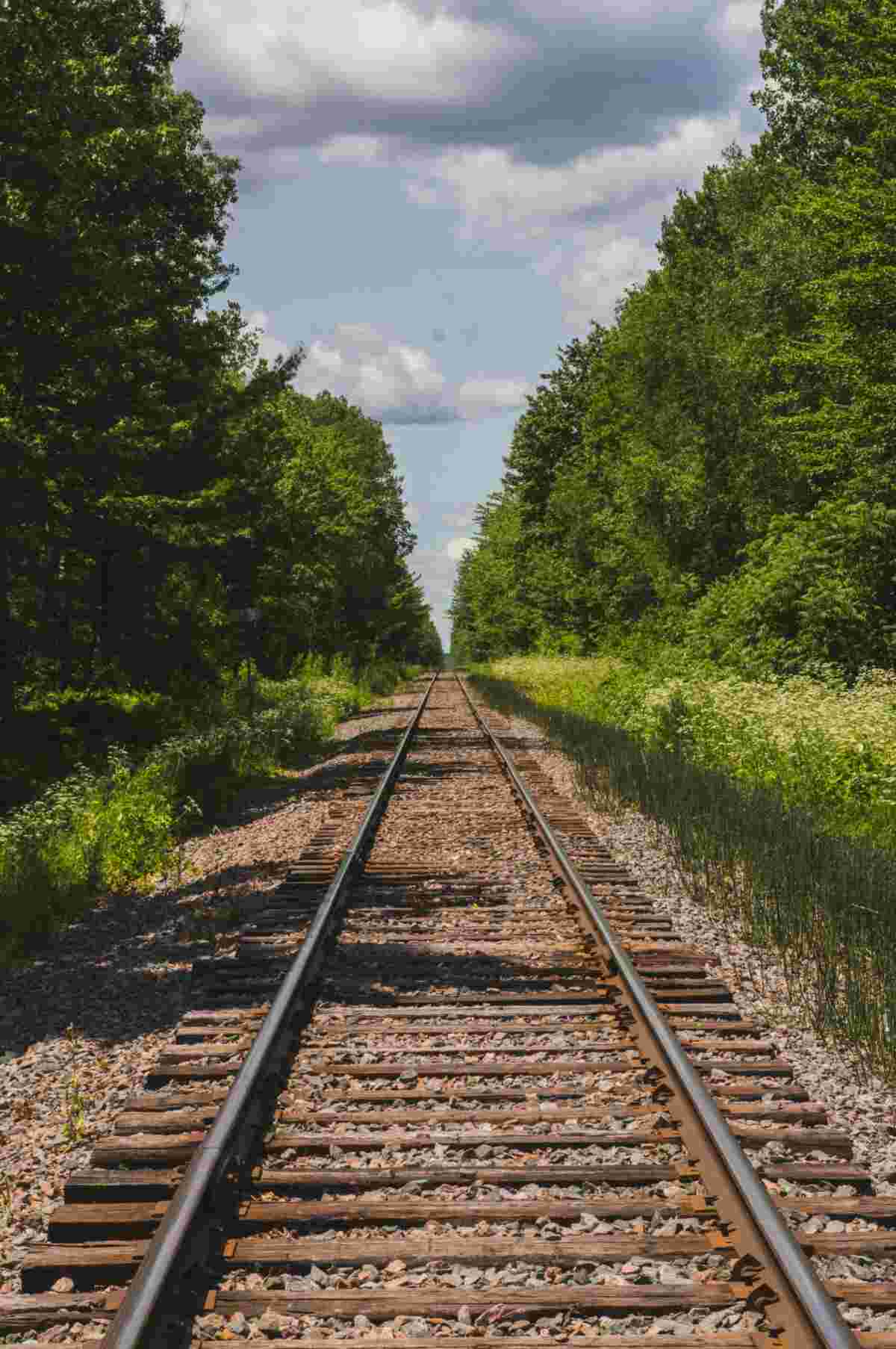
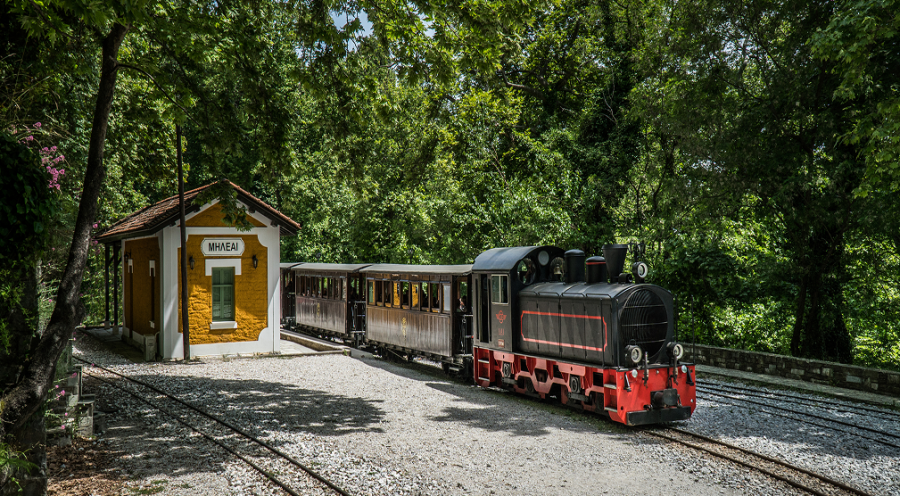
On the slopes of Mount Pelion—where the mountain meets the sea and the landscape seems to unfold at its own deliberate pace—the train becomes more than a means of transport. It becomes a way of seeing.
Its carriages run along one of the narrowest railway lines in the world, with a gauge of just 60 centimeters. First constructed in the late 19th century, the Pelion railway remains a living monument of rail architecture, tracing a lush route where nature and legend coexist.
The line
Built in two phases between 1892 and 1903, the railway played a decisive role in the development of the villages of Pelion. The works were overseen by Evaristo De Chirico, father of the painter Giorgio de Chirico.
As a child, the future artist often visited the construction site, observing the train—an image that would later echo through his work. In this sense, the railway did not only shape the landscape; it also left a trace on European artistic imagination.
Mythic Pelion
In Greek mythology, Mount Pelion was known as the mountain of the Centaurs. It is here that the Centauromachy—the battle between Centaurs and Lapiths—was said to have taken place, and where the wise Chiron lived.
The terrain itself—dense, layered, and at times impenetrable—seems to sustain these narratives, as if myth has not entirely withdrawn from the landscape.
The route
The train—known as “Moutzouris,” a nickname drawn from the soot of its early steam days—covers approximately 15 kilometers in about 90 minutes. The speed is slow, which enhances the experience.
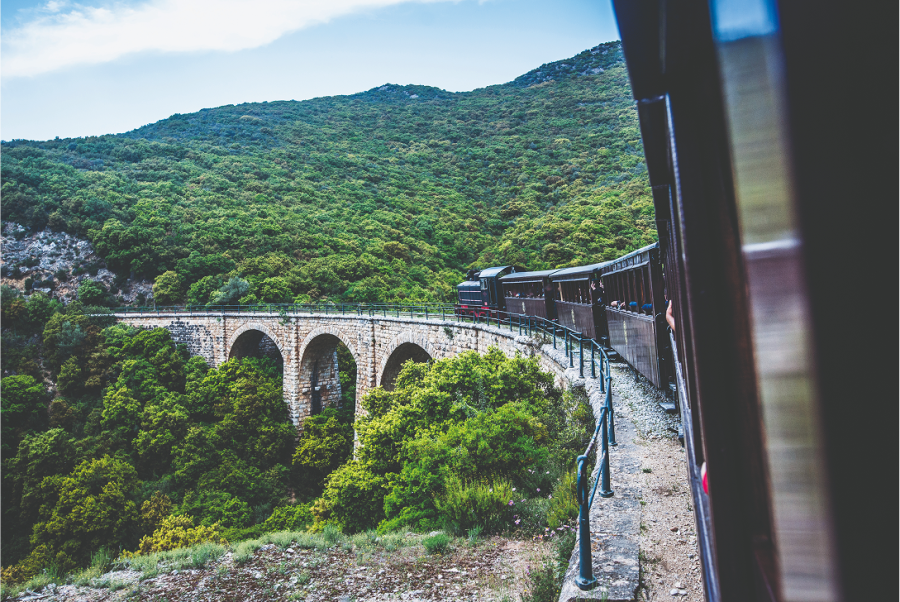
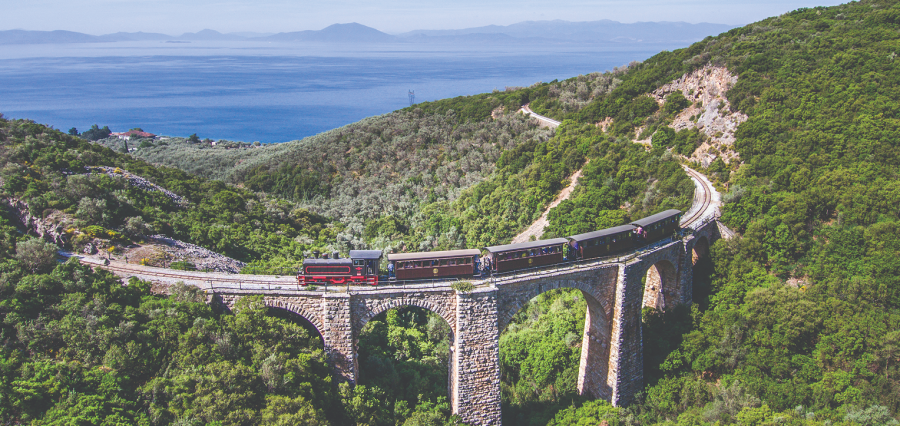
Along the way, nature and engineering unfold side by side. Stone structures of carved marble and grey limestone form retaining walls, arched bridges, vaults, and tunnel entrances, all integrated seamlessly into the terrain.
Among the highlights is the five-arched stone bridge of Kalorema, near Malaki. As the train approaches Milies, the landscape becomes more dramatic. Here stands the metal bridge of Taxiarchis—also known as the De Chirico bridge—where the train follows a curved path while the bridge itself remains straight, creating a striking visual contrast.
The destination
At the terminal station in Milies, the journey continues on foot. A traditional cobbled path leads into the village, where visitors can wander through narrow streets, discover guesthouses and small shops, and visit landmarks such as the Church of Taxiarchis (built before 1741), the folklore museum, and the historic library.
The journey does not end upon arrival—it simply changes pace.
Routes
| ANO LECHONIA – MILIES (Saturday – Sunday) | |||
| Itinerary Number | 3800 | 4802 | |
| Άνω Λεχώνια/Ano Lechonia | 10:00 | 13:30 | |
| Γατζέα/Gatzea | |||
| Arrival | 11:35 | ||
| Departure | 11:50 | 14:05 | |
| Μηλιές/Milies | 11:35 | 14:48 | |
|
|||||||
| Itinerary Number | 3801 | 4803 | |||||
| Μηλιές/Milies | 15:00 | 12:20 | |||||
| Γατζέα/Gatzea | |||||||
| Arrival | 15:40 | ||||||
| Departure | 15:55 | 12:38 | |||||
| Άνω Λεχώνια/Ano Lechonia | 16:30 | 13:13 | |||||
- Routes Download