IMPORTANT NOTICE
Hellenic Train informs the travelling public that, following a decision by Hellenic Railways S.A., regular services on the Diakopto – Kalavryta – Diakopto route, with intermediate stops at Niamata, Triklia, Mega Spilaio, Pliatsikoureika and Kerpini, are suspended until the suspension of the line’s operation is lifted by the Infrastructure Manager.
From sea level to the mountainous landscape of Kalavryta, this route condenses two distinct worlds into just 22 kilometers.
The Diakopto–Kalavryta Rack Railway—one of the rarest railway systems in the world—takes its name from the “teeth” that allow it to climb the mountain, adapting to gradients that conventional trains cannot negotiate. It is not simply a journey, but an encounter between landscape and engineering.
The route begins at Diakopto, along the shores of the Corinthian Gulf. For the first few minutes, the sea remains in view—before gradually receding, giving way to the gorge.
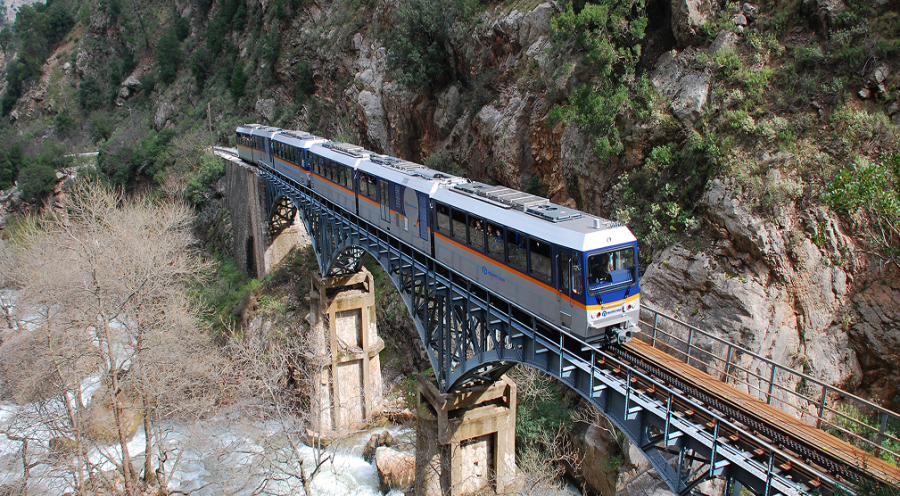
As the train enters the Vouraikos Gorge, the rhythm of the landscape shifts. Cliffs close in, water runs alongside the tracks, and a sequence of small and larger waterfalls emerges unexpectedly. This is not a route designed for distant viewing, but for immersion.
The train
The line was inaugurated in 1896, during the government of Charilaos Trikoupis, and remains an engineering landmark to this day, given the demanding terrain and elevation changes. The design was entrusted to French engineers, while construction and operation were undertaken by the Piraeus–Athens–Peloponnese Railways (SPAP).
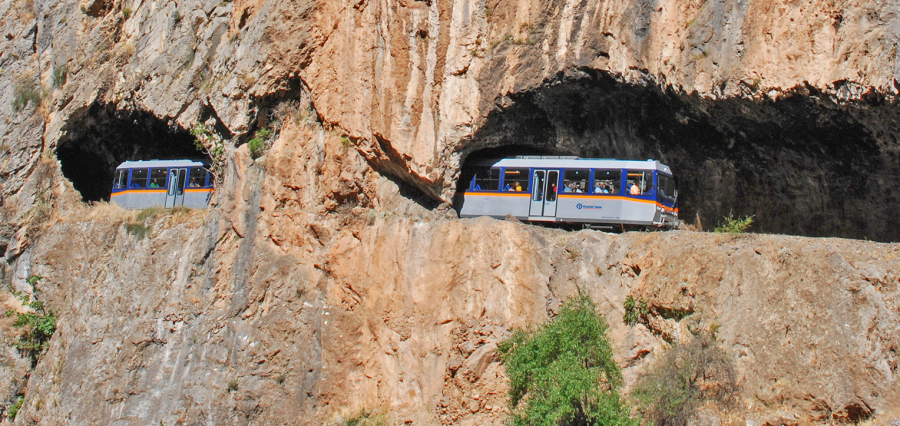
A defining feature of the project is the way it integrates into its environment. Using materials such as stone and timber, local craftsmen created a line that does not impose itself on the gorge, but appears to belong to it—almost as a natural extension of the landscape.
Kalavryta – Diakopto: Services may be modified during holiday periods, official public holidays and the summer season.
The route
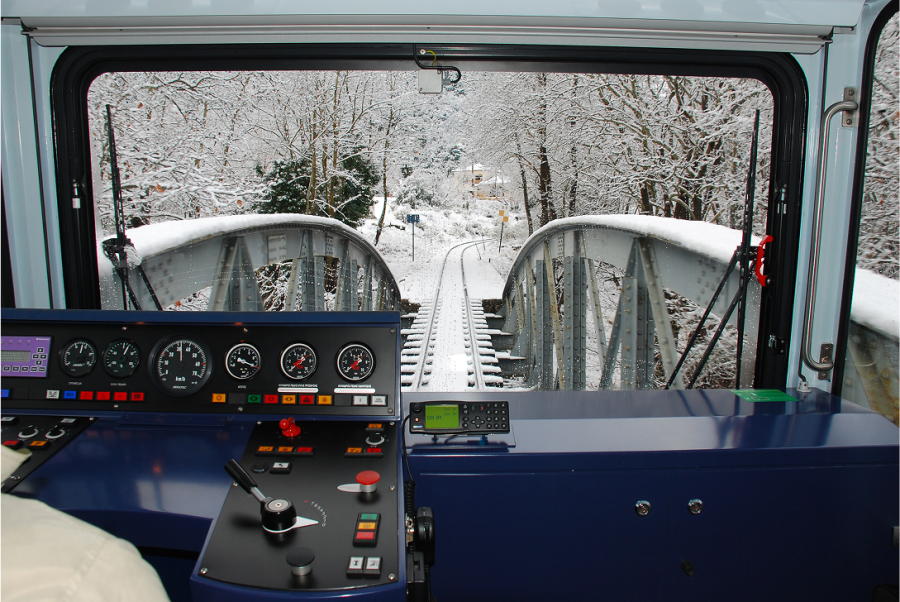
The rack railway is the most mountainous in Greece, with a narrow gauge of just 75 cm, allowing for smaller, more agile carriages. For much of the journey, the train operates on a conventional track; where gradients exceed 10%. However, it engages the rack system, locking onto a central toothed rail with specialized gears.
The total distance is 22 kilometers. Speeds range from 30–40 km/h on standard sections to 6–15 km/h on rack segments—a reduction that enhances, rather than limits, the experience.
Along the way, the train stops at Niámata and Triklia, while roughly halfway through the journey it pauses at Kato Zachlorou, serving visitors heading to the Monastery of Mega Spilaio. It then continues beneath the village of Kerpini before reaching its final destination in Kalavryta.
The place
Kalavryta and its surrounding region combine striking natural scenery with deep historical significance. The Agia Lavra Monastery, one of the most historic in Greece, is closely associated with the outbreak of the Greek War of Independence.
Nearby, the Hill of Kappi stands as a site of memory, marking the Massacre of Kalavryta in 1943—one of the most tragic episodes of the occupation period.
Today, the wider area is a year-round destination, where the mountainous landscape and the Kalavryta ski center coexist with the coastal setting of Diakopto—bringing together sea and mountain within a single journey.
| DIAKOPTO – KALAVRYTA | ||
| Itinerary Number | ||
| 1330 | 1332 | |
| Διακοπτό/Diakopto | 9:52 | 12:17 |
| Νιάματα/Niamata | 10:05 | 12:30 |
| Τρικλιά/Triklia | 10:23 | 12:48 |
| Μέγα Σπήλαιο/Mega Spilaio | 10:37 | 13:02 |
| Πλιατσικουρέικα/Pliatsikoureika | 10:44 | 13:09 |
| Κερπίνη/Kerpini | 10:51 | 13:16 |
| Καλάβρυτα/Kalavryta | 10:59 | 13:24 |
| KALAVRYTA – DIAKOPTO | ||
| Itinerary Number | ||
| 1331 | 1333 | |
| Καλάβρυτα/Kalavryta | 11:04 | 13:37 |
| Κερπίνη/Kerpini | 11:13 | 13:46 |
| Πλιατσικουρέικα/Pliatsikoureika | 11:20 | 13:53 |
| Μέγα Σπήλαιο/Mega Spilaio | 11:26 | 13:59 |
| Τρικλιά/Triklia | 11:40 | 14:17 |
| Νιάματα/Niamata | 11:58 | 14:35 |
| Διακοπτό/Diakopto | 12:11 | 14:48 |
- Route Download